
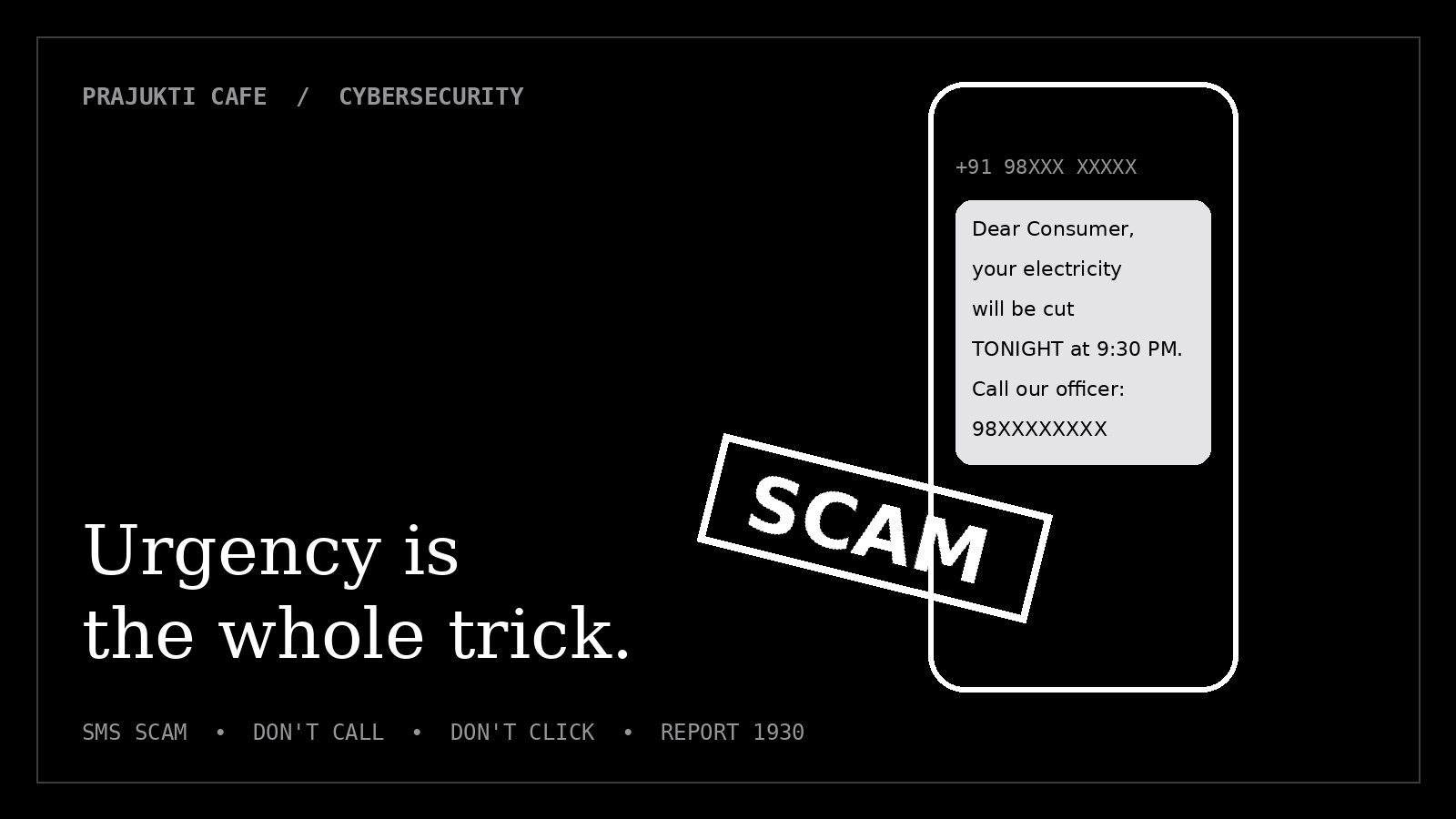
It arrives at 8 p.m., when offices are closed and panic is easy. The number looks official. The deadline is two hours. That’s the whole trick.
The fake electricity disconnection SMS has been reported across India for years, and it keeps working because it targets something everyone fears: sitting in the dark. Banks and police have repeatedly warned about it, yet people still lose money every week, often older family members.
Here is how it works, step by step, so you can recognise it instantly and warn the people you love.
What the message looks like
The wording changes, but a typical message looks something like this:
Dear Consumer, your electricity power will be disconnected tonight at 9:30 PM because your previous month bill was not updated. Please contact our electricity officer immediately on 98XXXXXXXX.
Notice what’s missing: no consumer number, no amount, no company name you can verify. Just fear, a deadline and a mobile number.
The scam, step by step
- The SMS arrives, usually in the evening, warning that your power will be cut within hours.
- You call the number. A polite “officer” says your last payment wasn’t updated in the system.
- They offer a quick fix: pay a small amount, often just ₹10 or ₹20, through a link they send, “to update your record”.
- Or they ask you to install an app so they can “help” you. It’s a genuine remote-access or screen-sharing app, but it lets them see and control your phone.
- They capture your details: card number, UPI PIN, or the OTP that appears on your screen.
- Money disappears, sometimes far more than the small amount you agreed to pay, often within minutes.
The small amount is bait. Scammers don’t want your ₹10; they want you to enter your card or UPI details, or to hand over control of your phone.
Red flags you can spot in seconds
| Red flag | Why it gives the scam away |
|---|---|
| Sent from a 10-digit mobile number | Genuine bill alerts usually come from a registered sender name, not a personal number |
| Asks you to call an “officer” | Power companies don’t route disconnections through personal phone numbers |
| Deadline of “tonight” | Urgency stops you from checking |
| Asks you to install an app | No genuine bill payment needs someone to control your phone |
| Asks for a small payment via a link | The link is designed to capture your card or UPI details |
| Odd grammar, no consumer number or amount | Official messages include account details you can verify |
How to check if a message is genuine
- Never use the number or link in the message.
- Open your electricity provider’s official app or website, or check your latest bill, and look at your payment status there.
- If you’re worried, call the customer care number printed on your bill or listed on the provider’s official website.
- Ask a neighbour if they got the same message. If everyone did, it’s almost certainly a scam.
If you have already responded
Act immediately. The first hour matters most.
- Disconnect the phone from the internet, and uninstall any app the caller asked you to install.
- Call your bank using the number on your card or the bank’s official website, and ask them to block your card, UPI and net banking.
- Report the fraud: call the national cyber crime helpline 1930, or file a complaint at cybercrime.gov.in. Reporting quickly can help stop the money moving further.
- Change your passwords and UPI PIN from a different, safe device.
- Keep evidence: screenshots of the SMS, the caller’s number and transaction details.
If you received the message but didn’t lose money, you can still help stop it: report the suspicious SMS or call through the Chakshu facility on the Department of Telecommunications’ Sanchar Saathi portal. Chakshu is for reporting suspected fraud messages; if money has already been lost, use 1930 or cybercrime.gov.in instead.
Share this with your family
Scams like this succeed because they catch people who’ve never heard of them. A two-minute conversation with your parents or grandparents can protect them better than any app:
- Power companies don’t threaten disconnection by personal SMS.
- Never call numbers from such messages.
- Never install an app because a stranger asks you to.
- Never share an OTP or UPI PIN with anyone.
Forward this article to your family group. It may be the most useful message they get this week.